
What guidelines say
The American Academy of Family Physicians recommends saline nasal irrigation as a non-drug option for children (over age 1) with the common cold, largely for symptom relief 1. ENT and allergy guidelines similarly support saline irrigation as an option to improve nasal symptoms and reduce medication use, noting that both isotonic and hypertonic saline are generally safe when prepared with clean water 2 3.
What systematic reviews show
Cochrane reviews from 2010 and 2015 examined randomized trials of saline irrigation for acute upper respiratory infections (including colds). These reviews found:
- Small improvements in nasal symptoms such as congestion and secretions
- Reduced use of decongestant medications in some studies
- Little or inconsistent evidence that saline clearly shortens the total length of illness
Importantly, most studies were small, used different methods, and had a high risk of bias, which limits confidence in the results 4 5.
Hypertonic saline: any added benefit?
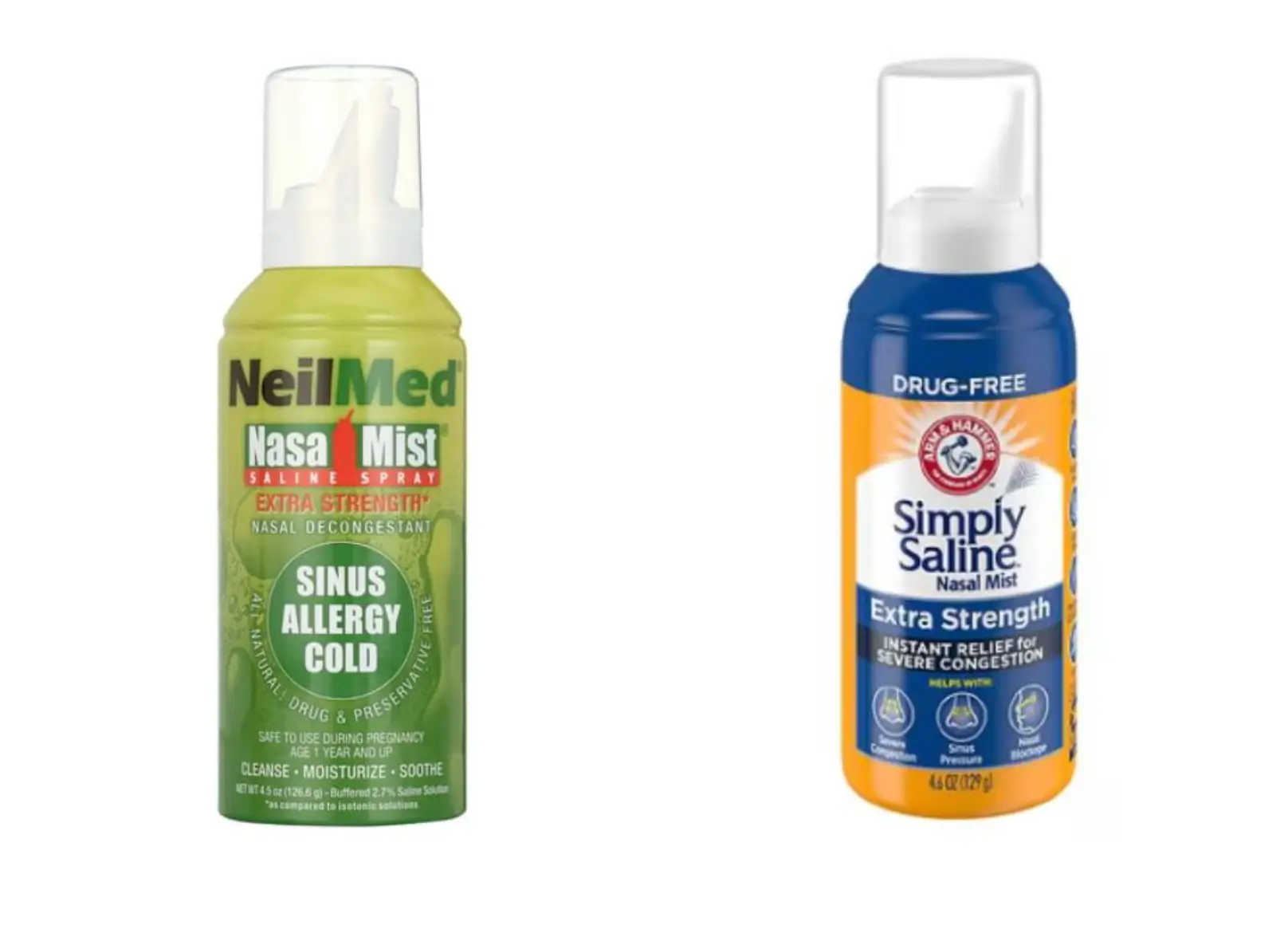
Hypertonic saline (typically 3–5% salt) may reduce nasal swelling and improve mucus clearance more than regular saline. Some guideline reviews note that large-volume hypertonic saline improved symptoms more than isotonic saline in certain studies, though others found no difference and reported more side effects such as burning or irritation 2.
Evidence for shortening illness
While most saline studies focus on symptoms, a few trials suggest a modest reduction in how long people feel sick, especially when saline is used frequently and early. Studies examining viral infections (including common cold viruses and COVID-19) suggest that nasal irrigation can reduce viral load in the nose, which may help recovery occur sooner 6.
However, when saline is used as a placebo in trials of antiviral nasal sprays, it often shows enough benefit to mask differences between treatment groups, suggesting saline itself does provide some real—but limited—clinical effect 7.
Safety
Saline nasal irrigation is considered very safe. Mild burning, irritation, or nosebleeds can occur, particularly with hypertonic solutions. All major guidelines stress the importance of using distilled, sterile, or boiled water to prevent rare but serious infections 2 3.
Bottom line
- Nasal saline irrigation helps relieve cold symptoms, especially congestion and thick mucus.
- Evidence that it shortens the duration of a cold is mixed but suggests a small potential benefit, particularly with frequent use and hypertonic solutions.
- Benefits are modest—not dramatic—but the treatment is low-risk and inexpensive.
- Hypertonic saline may help some people more than regular saline, though it can be less comfortable.
For people looking to feel better sooner during a cold, nasal saline—especially a hypertonic solution, when started early—may help a little, even if it’s not a cure.
Sources:
1. https://www.ncbi.nlm.nih.gov/pubmed/31478634?dopt=Abstract#4e91ec9a. American Family Physician. (2019).
2. https://onlinelibrary.wiley.com/doi/full/10.1002/ohn.1344#ad339cee. Otolaryngology–Head and Neck Surgery. (2025).
3. https://pubmed.ncbi.nlm.nih.gov/32707227/?dopt=Abstract#75d3ffc7. The Journal of Allergy and Clinical Immunology. (2020).
4. http://onlinelibrary.wiley.com/doi/10.1002/14651858.CD006821.pub3/abstract;jsessionid=E6CE44A19D7603DEFA4C9FA5E275CF26.f01t01#727978fa. The Cochrane Database of Systematic Reviews. (2015).
5. https://pubmed.ncbi.nlm.nih.gov/20238351#cfa7155d. The Cochrane Database of Systematic Reviews. (2010).
6. https://pmc.ncbi.nlm.nih.gov/articles/PMC7453155#c60a5ae7. Ear, Nose, & Throat Journal. (2021).
7. https://pmc.ncbi.nlm.nih.gov/articles/PMC3840586#0d152ddc. Respiratory Research. (2013).